en
en
 Français



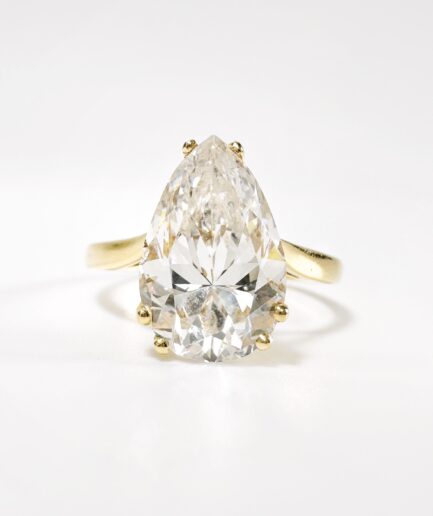
Gold pear-shaped Rhinestone solitaire ring “Aubrine”
$433
unique piece, 1 item available
Description
Sublime solitaire ring from the 50s in 18k yellow gold set with a 3-carat pear-shaped Rhinestone mounted in a claw on an open bezel giving it light and sparkle. Mounted on a simple gold band, this teardrop-cut stone elongates the finger for the most delicate and elegant effect. Note a slight chip at the lower left corner of the stone.
Size: FR 52 / US 6 / UK M
Weight: 3.19g
Eagle Hallmark
This unique piece had a previous life in France.
The story: the solitaire is the engagement ring par excellence. Designating a unique stone, a symbol of a love that is just as unique, it can honor any stone in the world of gemology. At the end of the nineteenth century and the beginning of the twentieth, the Rhinestone — a lead-cut crystal imitating the brilliance of diamonds — became a staple of French jewelry. Prized for its generous shine and accessibility, it seduced both Parisian houses and provincial workshops, which integrated it into solitary rings, luminous brooches or ball sets. Heir to the romantic taste of the Second Empire and the splendour of the Belle Époque, Rhinestone is part of an aesthetic where the sparkle counts as much as the symbol. Before the generalization of modern imitations, this cut crystal embodied the charm of elegant and theatrical jewelry, typical of the French art of living at the turn of the century.